
The KV Weekly Digest #7
The End of Natural Monopoly – A Schumpeterian Shift in the electric power sector


I had planned to write about increasing electricity prices and provide some analysis of various recent reports detailing the trends and the heterogeneity of prices in the U.S. for the newsletter this week. The price story is currently a clash of two narratives that cannot both be true in the way they are being presented.
The first is the PowerLines finding that U.S. utilities requested a record $31 billion in rate increases in 2025, roughly double the requests in 2024, which reinforces the increasingly common claim that the capital requirements of the energy transition, grid hardening, and load growth are now flowing directly into customer bills. The second is the Edison Electric Institute’s analysis done by Charles Rivers Associate showing that, across a longer time horizon and in a majority of states, electricity rates have remained comparatively stable, which utilities and their advocates use to argue that the current round of increases is being mischaracterized.
Layered on top of both stories is the “data-center explanation”, the idea that the sudden scale of hyperscaler and AI load is forcing an acceleration of generation and network investment and that this, rather than any structural feature of the regulatory system, is the primary driver of new rate cases. The hyperscalers like Anthropic and Microsoft have responded by saying that they are willing to pay the full incremental cost of the infrastructure required to serve them, in some cases more than 100% in order to avoid shifting those costs onto other customers.
That is where I started, then I came across Heatmap’s February 3, 2025, feature, “A Not-So-Natural Monopoly.” and the price story stopped being the main story.
The Question Beneath the Price Debate
Once you ask whether the network is actually a natural monopoly, the entire argument about who should pay for its expansion changes. If transmission and distribution are inherently single-provider systems, then the only mechanism for financing is the regulatory process. But if the network is not inherently a monopoly, then a customer willing to finance its own generation and wires does not need a rate case at all. It needs the contractual and legal right to build.
The Heatmap newsletter starts with this provocative quote:
“Everyone knows the transmission system is a natural monopoly. But Travis Fisher and Glen Lyons want you to consider ... maybe it isn’t?”
Travis Fisher of the Cato Institute and Glen Lyons of the Advocates for Consumer Regulated Electricity (ACRE) proposed the Consumer-Regulated Electricity Utility (CREU) model, which is now backed by the American Legislative Exchange Council (ALEC). At its fundamental level, the CREU model challenges the natural monopoly argument used as a justification for price regulation within the electric power sector. It provides the legal and political framework in which entry into the network business is possible by requiring new systems to be physically islanded from the existing grid and therefore outside the jurisdictional structure built on the natural-monopoly assumption.
In the Heatmap newsletter:
“CRE would not be regulated under existing federal law, and would have no connection to the existing grid, allowing for novel price structures and even physical set-ups, like running on different frequencies or even direct current…”
For the first time in a century, generation, transmission, distribution and load could be assembled in an integrated system governed by contract rather than franchise. This was the core argument of my paper, Condemnation for Transmission, which investigated why merchant transmission projects fail or have struggled despite willing counterparties. The answer is not economics; it is law and politics.
The Natural Monopoly That Wasn’t
The historical record is clear: the electric power sector did not originate as a monopoly. In 1887 alone, six electric companies were organized in New York City. By 1907, forty-five firms held the legal right to operate in Chicago. Duluth was served by five competing systems before 1895, and Scranton had four as late as 1906. These were not isolated experiments but evidence of a dense and rivalrous market in which multiple firms built overlapping networks and competed for the same customers.
It was in this environment that the so-called “Current Wars” unfolded, as Thomas Edison and his followers promoted direct current while George Westinghouse and his allies advanced alternating current. That episode was not merely a technological dispute; it was a demonstration of the competitive process itself. The eventual dominance of AC was not the result of administrative design but of market rivalry, which selected the system that could deliver power more efficiently over long distances and at lower cost to consumers.
The industry’s heavy capital requirements – later invoked as proof that competition was impossible – were in fact met through entrepreneurial innovation. Electrical equipment manufacturers routinely created utilities and then sold them to outside investors in order to free capital for further expansion, recognizing that operating a utility required a managerial and bureaucratic capacity they did not possess. Financial holding companies emerged as the solution. As Hausman, Wilkins, and Neufeld document, European and American firms in the mid-1890s began organizing such structures to finance and control utility systems, often using debt instruments to obtain effective control with relatively little equity.
What this early period shows is not a sector collapsing under the weight of its own fixed costs, but a market adapting to those costs through entrepreneurship, financial innovation, and technological competition. The organizational forms that later made large-scale electrification possible were themselves products of rivalry. The capital problem was solved by the market before it was used as the justification for monopoly.
The Man Who Rewired the Industry into a Monopoly
What ultimately displaced this competitive structure was the political transformation of the industry led by Samuel Insull, the most influential utility entrepreneur of his generation. To understand how the natural-monopoly idea became embedded in the electric power sector, one must first grasp the scale of Insull’s power. By the late 1920s, the holding-company system he controlled supplied roughly one-sixth of all electricity consumed in the United States. The modern successors to that network – ComEd, WEC Energy Group, NIPSCO, Consumers Energy, Ameren Missouri, and parts of Xcel – still form the backbone of the Midwestern grid. More important than their physical footprint, however, was the institutional template he created. Insull standardized accounting practices, metering, load diversity, rate design, and financing structures to such an extent that regulators and competitors alike came to treat his model not as one possible form of organization but as the definition of what a utility was.
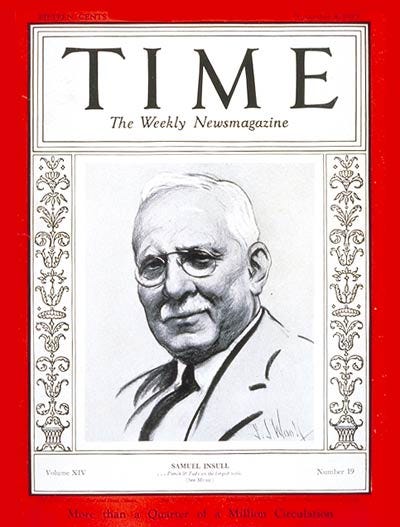
There are moments when history itself seems to bend under the sheer force of a single individual’s will. For the Bolsheviks, that figure was Lenin on the eve of the October Revolution. For the American electric power sector, it was Samuel Insull. In 1898, standing before the National Electric Light Association as the most successful electricity entrepreneur in the world, Insull urged the industry to place itself under the authority of government commissions empowered to fix rates and service standards and to rewrite franchise agreements so that municipalities could acquire underperforming systems. This was not a concession to the failure of competition; it was a deliberate effort to stabilize capital, eliminate price wars, and secure exclusive service territories. He wanted what he later called a “quiet life,” and he sought it through regulation.
Within a generation, that vision had been translated into law. Beginning with Wisconsin and New York in 1907, regulatory commissions spread rapidly across the country, and by 1918 nearly every state had established one. The natural monopoly in electricity was not discovered in the cost structure of the T&D network; it was constructed through the institutional settlement that Insull helped bring into being.
Some would argue that the intellectual ascendancy of neoclassical economics made price regulation in the power sector inevitable. I disagree. The decisive force was Samuel Insull.
Challenging the Theoretical Pillars
The persistence of the natural-monopoly view in transmission and distribution rests on a small set of familiar claims: that economies of scale drive average costs down as output expands, that the sector’s fixed costs are too large to sustain more than one firm, and that duplicating networks is socially wasteful or an inconvenience to customers. These propositions are repeated so often that they are treated as empirical facts rather than hypotheses.
But none of them withstands close examination.
High fixed costs do not produce monopoly; unrecoverable costs do. Oil fields, refineries, and pipelines require immense capital, yet they exist in competitive markets because the assets retain value outside any single firm. This was precisely the point made by Baumol, Panzar, and Willig in their theory of contestable markets: the relevant distinction is not between fixed and variable costs, but between recoverable and sunk costs. Where investment can be redeployed or sold, and entry remains possible, incumbents are disciplined, regardless of how large the initial capital requirements may be.
The claim that duplicating wires is inherently inefficient also collapses under historical scrutiny. In 1965, when Lubbock Power & Light began installing underground residential distribution due to the aesthetic concerns of customers, its private competitor immediately followed to retain customers in Lubbock Texas. Around the same time in Poplar Bluff and Sikeston Missouri, overlapping distribution systems improved responsiveness and reliability because customers had a choice. Competition did not produce chaos. It accelerated modernization and raised service quality. Today, grid-resilience strategies routinely call for burying lines – an outcome that likely would have emerged far earlier had competition been allowed to develop across the sector.
Empirical work points in the same direction. Walter Primeaux 1975 study of utility market structures found that firms operating in direct competition reduced their average costs more effectively than those protected by rate-of-return regulation. Competitive pressure disciplined operating expenses in ways administrative oversight could not replicate. In other words, the cost curve did not create monopoly; the absence of competition allowed costs to rise.
As of January 1, 1966, direct competition in electricity distribution was not an anomaly: across sixteen states, forty-nine cities were still served by at least two utilities vying for the same customers.
The Merchant Transmission Barrier
This theoretical reconsideration is not merely historical. The contemporary experience of merchant transmission developers – most notably Clean Line Energy Partners – shows that the central constraint on new T&D network investment is not economic feasibility but institutional design.
These firms proposed projects that would move low-cost energy to high-value markets under long-term contracts, fully exposed to market risk and without regulated cost recovery. They failed not because the projects were uneconomic, but because the legal structure of the industry ties the right to build, the power of eminent domain, and the ability to recover costs to the status of incumbent utility.
The Certificate of Public Convenience and Necessity functions less as a test of public need than as a barrier to entry.
In that sense, merchant transmission companies are not anomalies; they are signals. They demonstrate that the physical T&D network can be financed outside the traditional monopoly framework and that the real obstacle is the regulatory architecture that prevents new entrants from assembling the necessary rights and assets.
Their emergence points toward a different organizational model for the sector – one in which transmission investment is governed by contracts and market risk rather than by exclusive territories and guaranteed returns – and in doing so it weakens the central empirical claim on which the natural-monopoly theory depends.
The CREU Model and a Schumpeterian Future
The data-center moment is exposing the mismatch between our institutional form and our technological reality. Hyperscalers need power delivered on timelines that feel like the speed of light in the current regulatory structure.
That is why the CREU model matters. It creates the possibility of full-stack power companies – privately financed systems in which generation, transmission, and load are assembled under a single capital structure and governed by contract.
This is a Schumpeterian shift.
For a century, innovation in electricity has occurred inside a fixed institutional structure. Now innovation can occur at the level of firm architecture itself – financing, construction speed, risk allocation, and pricing.
We move from a world in the utility rate base determines the pace of infrastructure, to one in which multiple infrastructure platforms compete. And to be honest, I would love more entrepreneurs to build more transmission and distribution companies.
In the Heatmap piece, Travis Fisher joked that only four people – himself, Glen Lyons, Joseph Schumpeter, and Wayne Crews – believe transmission might not be a natural monopoly.
He is wrong. The natural monopoly in electricity is not a physical law. It is a legal artifact. And there are more than four of us.
I am one of them.